As a product manager, keeping up with evolving customer needs is a core part of my job. I do this through regular chats with customers and prospects. These conversations tend to surface pain-points that are common across customers. And solving such recurring frustrations is what leads to great products.
Getting to that final product, however, is an iterative process. Customer conversations turn into prototypes, which are then refined through further feedback rounds, until we have the final product. The goal here is twofold: first, confirm that the customer problem is actually worth solving; second, ensure that the solution we build is the right one for the problem. This iterative process of identifying the correct customer problems and building the right product for them is called product discovery.
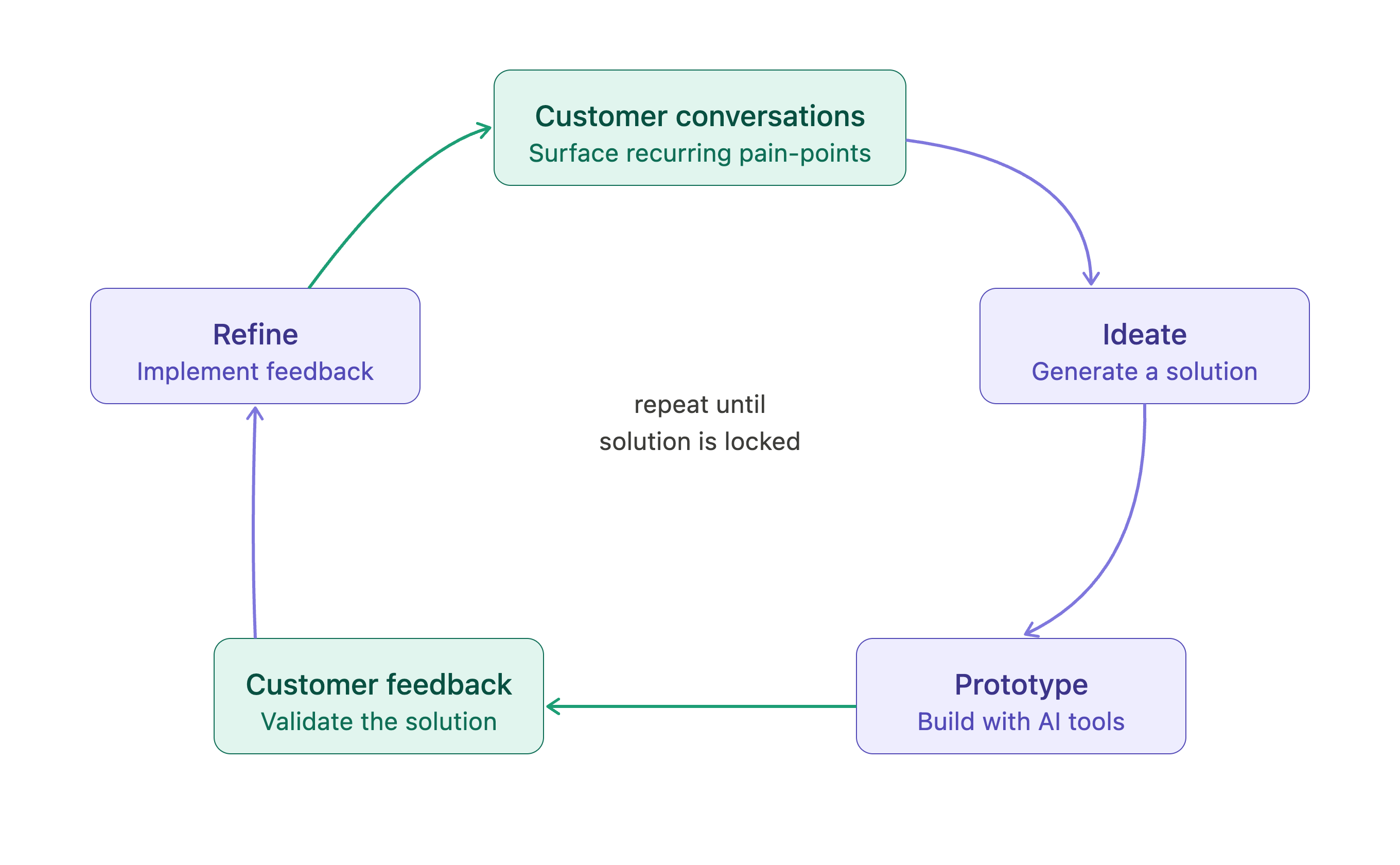 The product discovery loop
The speed at which this loop is run matters a lot here. The sooner we find the right solution, the faster it gets built. In the past, prototyping has been a bottleneck in this process. Customers love interactive demos that explain how a product addresses their problem. But creating such interactive prototypes is time consuming, and required coding expertise which I did not have. This meant prototyping was at the mercy of the Engineering team’s availability. And because they were often focused on higher priority work, there was rarely any bandwidth for prototype creation. Designers, who would normally help with mocks had the same bandwidth constraint. So I relied on tools like Powerpoint to create static mockups. While helpful, these mockups were limited in their ability to show real interactions.
Agentic coding tools have largely solved this problem for me. These are AI powered tools which you can converse with, to create software. You go through the customer problem and solution with the AI, and it codes up the prototype for you in no time. Instead of a static mockup, today I can create a functional, interactive dashboard in under 30 minutes. The dashboard can use real data and provide actual insights, unlike a static mock. And iterating on feedback is just as fast; I describe the changes and AI implements them. This cycle would have taken weeks in the pre-AI era, but now it’s just hours.
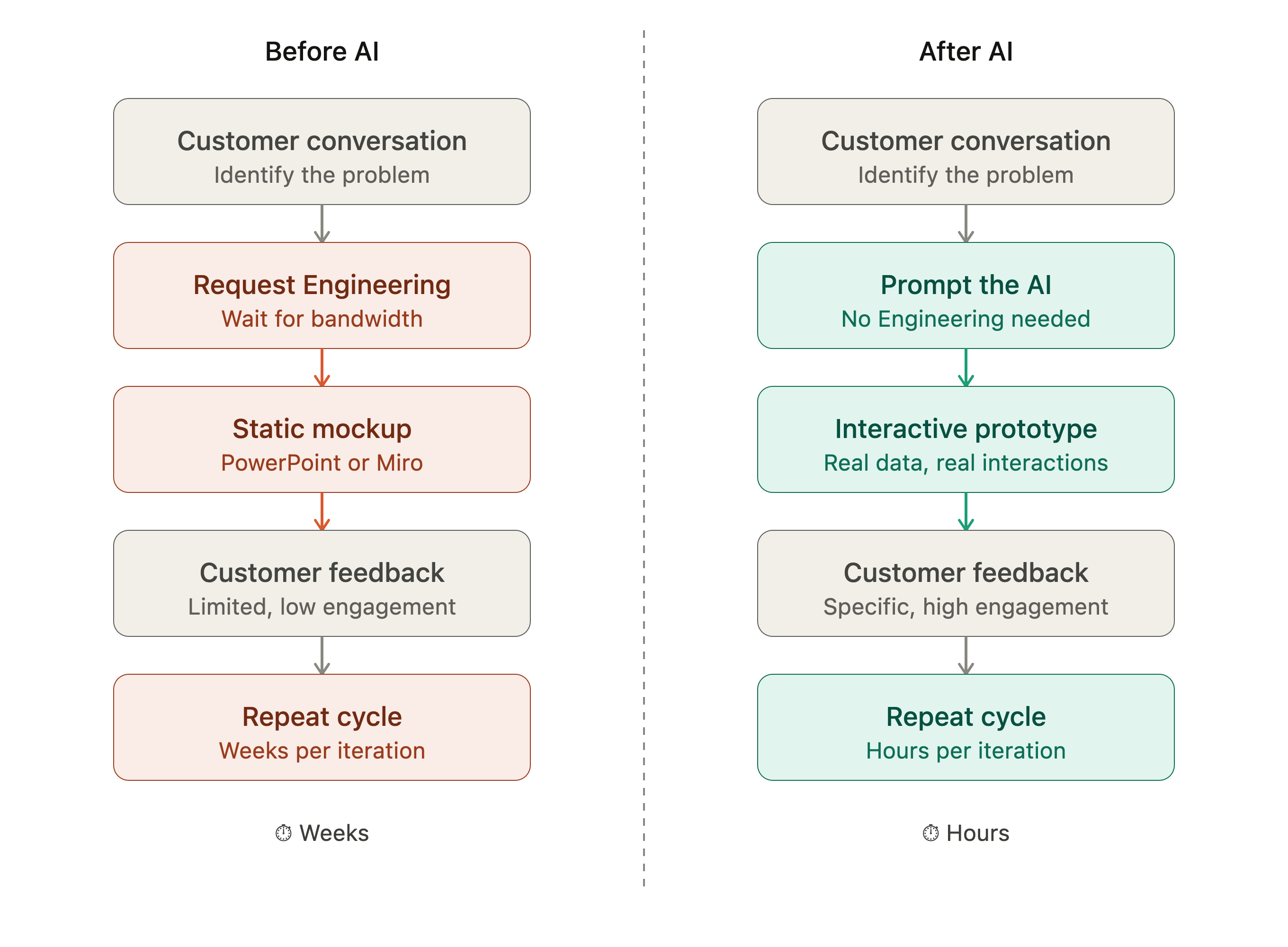 The acceleration with AI
Apart from speed, another important benefit is the improvements in the quality of feedback. Customers are more engaged with the new interactive demos, they ask better questions and provide more specific feedback.The new prototypes are better received internally as well. Design teams appreciate that I can independently do early exploration and bring more refined prototypes for design discussion. Business teams can clearly see how a solution solves customer problems, which speeds up alignment. And Engineering is able to use the prototypes as specification for what to build, reducing the back and forth during development.
The process, however, has not been a walk in the park. Setting up the agentic coding workflow took some work. I use Github Copilot, which has the benefit of having several models available. This benefit turned out to be a bottleneck when I started. Finding the right model from the available ones took some trial and error. OpenAI and Gemini models were not up to par at the time for front-end design. But Anthropic models turned out to be excellent at creating aesthetic visuals. They even had better visual intuition than me.
Model selection was not the only challenge though. I wanted the prototypes to follow a consistent design language and adhere to brand guidelines. Designers have put in significant time to form the brand identity and codify it in brand guidelines documents. I wanted the AI to abide by these guidelines when creating prototypes. The solution was a Skills file. A Skills file is a document that provides AI instructions on how to do specific tasks. In my case, the file was derived from brand guidelines and contained instructions on colours, typography, and interaction patterns. The AI refers to this document during every prototype build to create consistent designs.
Can PMs now contribute to production software using agentic coding tools? Frankly, I don’t know the answer to this yet. PMs are usually not good judges of code quality. We can verify if the code meets business needs, but PMs lack the expertise to review non-functional requirements like security and performance. The sheer volume of AI generated code is also not something a human can review easily. In mission critical domains like the one I work in, we still need human oversight over every feature that is delivered.
While I don’t have a definitive answer yet, the gains in iteration speed have been big enough to make changes to the way I work, and that feels like a meaningful start.